Tire rotation moves tires between positions on your vehicle, balancing corrects uneven weight distribution within a tire, and alignment adjusts the angles of your wheels relative to each other and the road. All three are distinct services with different intervals, costs, and consequences when skipped.
Most drivers lump these three services together or assume a shop handles all of them at once. They don't - and confusing them leads to premature tire wear, poor fuel economy, and unsafe handling. Here's exactly what each service does, when you need it, and why skipping it costs you more in the long run.
Tire Rotation: Equalizing Wear Across All Four Tires
Tire rotation is the physical process of moving each tire to a different wheel position - front-left to rear-right, for example - so that no single tire bears a disproportionate load over time.
Front tires on a front-wheel-drive vehicle do most of the steering, braking, and power delivery. They wear 2–3 times faster than rear tires. Without rotation, you'd replace your front tires at 25,000 miles while the rears still had 50,000 miles of life left. Rotation evens that out, maximizing the lifespan of all four tires simultaneously.
Common rotation patterns include:
- Forward cross: Rears move straight forward; fronts cross to the opposite rear. Best for front-wheel-drive vehicles.
- X-pattern: All four tires cross to the opposite axle and side. Used on front-wheel-drive vehicles with significant wear differences.
- Rearward cross: Fronts move straight back; rears cross to the opposite front. Best for rear-wheel-drive and all-wheel-drive vehicles.
- Side-to-side: Used only with non-directional tires of different front/rear sizes (common on performance vehicles).
Recommended interval: Every 5,000–7,500 miles, or every oil change if you're on a 5,000-mile service schedule. Check your owner's manual - some AWD manufacturers specify tighter intervals, as little as 3,500 miles, to protect the center differential.
Tire Balancing: Eliminating Vibration Caused by Weight Imbalance
Tire balancing corrects uneven weight distribution around a tire-and-wheel assembly. Even a brand-new tire mounted on a perfectly machined wheel has microscopic variations in rubber density and wheel casting. Those imperfections create a heavy spot that causes vibration at speed.
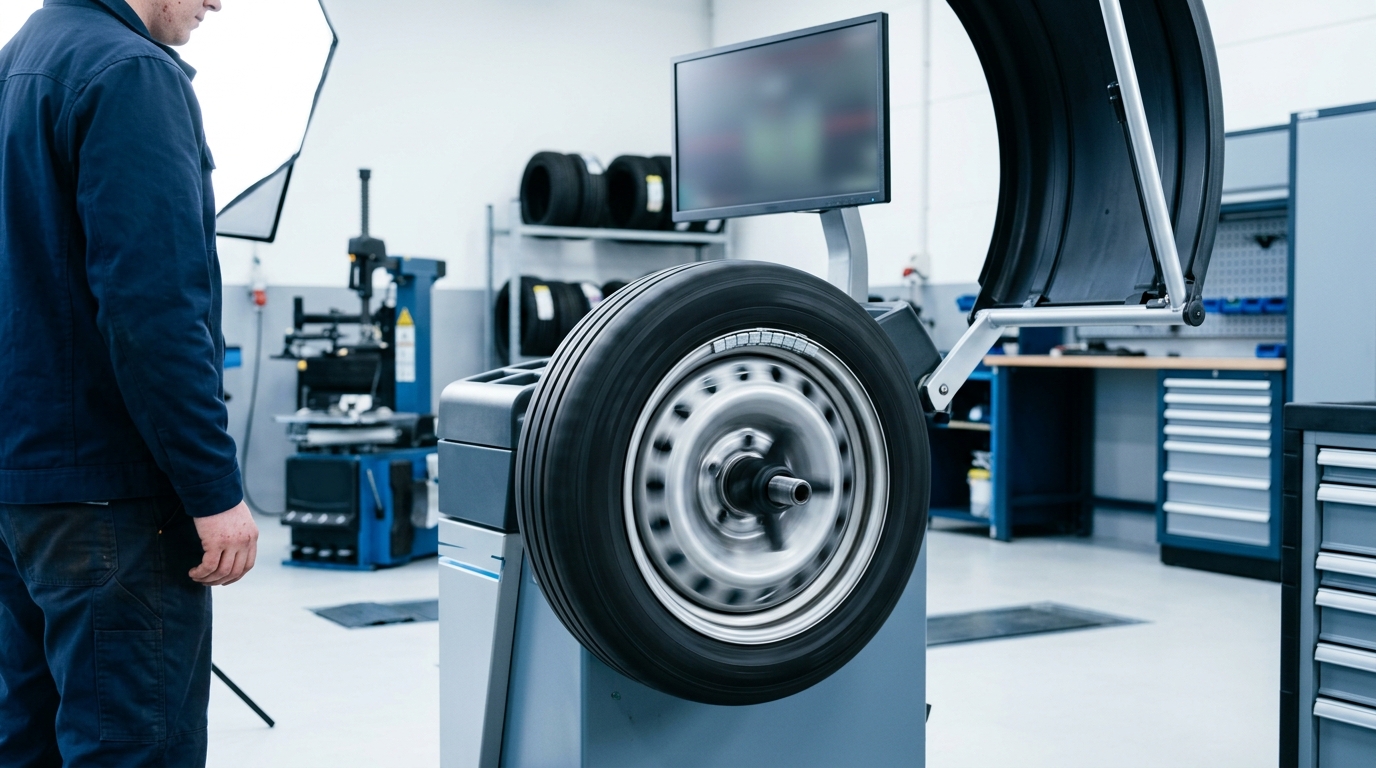
A balancing machine spins the tire-wheel assembly and pinpoints exactly where weight is missing. A technician then attaches small lead or zinc weights - typically 0.25 oz to 2 oz - to the rim to offset the heavy spot. The goal is a perfectly balanced rotation with no wobble.
Two types of balancing exist:
- Static balancing: Corrects up-and-down bounce (single plane). Older method, less precise.
- Dynamic balancing: Corrects both up-and-down and side-to-side wobble (two planes). The standard at virtually all modern shops.
Signs you need balancing:
- Steering wheel vibration at 55–70 mph that smooths out at higher or lower speeds
- Vibration felt in the seat or floorboard (often a rear tire issue)
- Cupped or scalloped wear pattern on the tire tread
Recommended interval: Every 12,000–15,000 miles, every time a tire is dismounted and remounted, or whenever you feel vibration. Tires also go out of balance when wheel weights fall off - a common occurrence after hitting a pothole.
Wheel Alignment: Correcting the Angles That Determine How Your Tires Meet the Road
Wheel alignment adjusts three geometric angles - camber, toe, and caster - so all four tires contact the pavement at the optimal angle. Misalignment doesn't cause vibration the way imbalance does; instead, it causes pulling, uneven tire wear, and reduced fuel efficiency.
The three alignment angles explained:
- Camber: The inward or outward tilt of the tire when viewed from the front. Negative camber (top of tire tilts inward) improves cornering grip but causes inner-edge wear if excessive.
- Toe: Whether the fronts of the tires point inward (toe-in) or outward (toe-out) when viewed from above. Even 1/8 inch of toe misalignment causes significant tire wear and fuel drag.
- Caster: The forward or backward tilt of the steering axis when viewed from the side. Positive caster improves straight-line stability and steering return-to-center.
Alignment is adjusted using a computerized alignment rack that reads each angle precisely, then a technician adjusts tie rods, control arm positions, or eccentric bolts to bring everything into manufacturer spec. A proper four-wheel alignment addresses all three angles on all four wheels.
Signs you need alignment:
- Vehicle pulls left or right on a level, straight road
- Steering wheel sits off-center when driving straight
- Rapid or uneven tire wear - one edge wearing much faster than the other
- Loose or imprecise steering feel
Recommended interval: Every 10,000–12,000 miles, after any significant impact (pothole, curb strike, minor collision), or whenever you replace tires. Many manufacturers recommend checking alignment annually.
Side-by-Side Comparison: Rotation vs. Balancing vs. Alignment
Factor Rotation Balancing Alignment What it fixes Uneven wear between tires Weight imbalance in a tire-wheel assembly Incorrect wheel angles Main symptom when needed Tires wearing unevenly by position Steering wheel or seat vibration at speed Vehicle pulling, off-center steering Typical interval 5,000–7,500 miles 12,000–15,000 miles 10,000–12,000 miles or annually Typical cost (2026) $20–$50 $40–$80 (all four) $80–$175 (four-wheel) Triggered by impact? No Yes (lost wheel weights) Yes (pothole, curb strike) Done during tire change? Recommended Always (new mount) RecommendedCan You Do All Three at the Same Time?
Yes, and combining them saves time and money. Most tire shops offer a rotation-and-balance package. When you're buying new tires, do all three - mount, balance, and alignment - in one visit. You'll leave the shop knowing every angle is correct and every tire has equal life ahead of it.
That said, the services solve different problems. Don't assume getting one means you got the others. Always ask the service advisor explicitly which services are included.
What Happens If You Skip These Services?
Skipping rotation costs you $600–$1,200 in premature tire replacement. Skipping balancing wears out shocks and struts faster through sustained vibration. Skipping alignment is the most expensive mistake - a toe misalignment of just 0.17 inches drags your tire sideways the equivalent of 28 feet for every mile driven, burning through tread at a rate most drivers don't notice until it's too late.
Combined neglect shortens tire life from a typical 50,000–70,000 miles down to 25,000–35,000 miles. At current tire prices, that's a real financial loss - not a theoretical one.
How often should I rotate my tires?
Rotate your tires every 5,000–7,500 miles. Many drivers tie rotation to every oil change for simplicity. AWD vehicles often need rotation every 3,500–5,000 miles per manufacturer spec to protect the drivetrain.
Does tire balancing affect alignment?
No. Balancing corrects weight distribution within a single tire-wheel assembly. Alignment adjusts the geometric angles of your wheels relative to the vehicle frame. They are completely separate systems, require different equipment, and solve different problems.
How do I know if my wheels are out of alignment vs. out of balance?
Imbalance causes vibration - usually felt in the steering wheel at 55–70 mph. Misalignment causes pulling to one side, an off-center steering wheel, or uneven tire wear without vibration. You can have both problems simultaneously, which is why shops check both after a significant road impact.
Do I need an alignment after every tire rotation?
No. Rotation itself does not change wheel angles. You need alignment when you hit something hard, when you notice pulling or uneven wear, when you replace tires, or on a 10,000–12,000 mile interval - not at every rotation.
Is a two-wheel alignment ever sufficient?
On older vehicles with a solid rear axle (many trucks and older SUVs), only front-wheel alignment is adjustable, making a two-wheel (front-end) alignment sufficient. On virtually all modern cars and crossovers with independent rear suspension, a four-wheel alignment is necessary to bring all four wheels into spec. Always confirm your vehicle's suspension type before paying for a limited service.